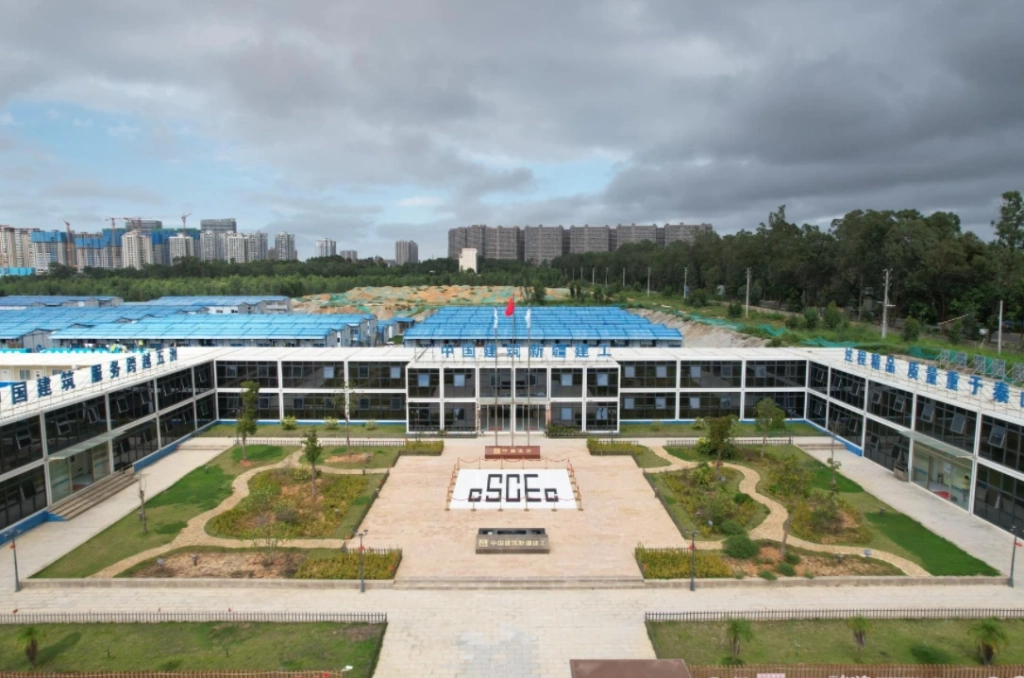
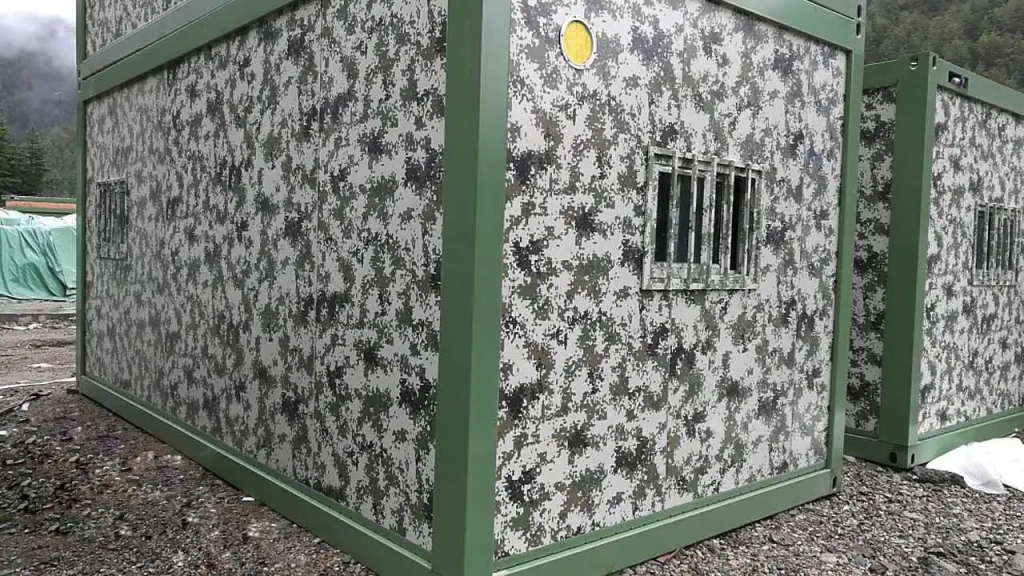
Modern military operations are often carried out in remote locations, unstable environments, or disaster-affected areas. Under these circumstances, traditional construction methods are often too slow to meet urgent deployment needs. Service personnel require structures that can be quickly transported, easily assembled, and scaled as project requirements evolve. And this is precisely where modular construction plays a critical role.
GS Housing has years of experience in developing prefabricated modular building systems tailored for tough conditions. Equipped with broad production ability and background in structures, extraction, power, aid operations, and protection initiatives, the firm provides reliable on-site structures that can be quickly installed and perform safely over the long term.
Before exploring the technical details, it is important to understand why rapid deployment structures have become essential for modern military camps.
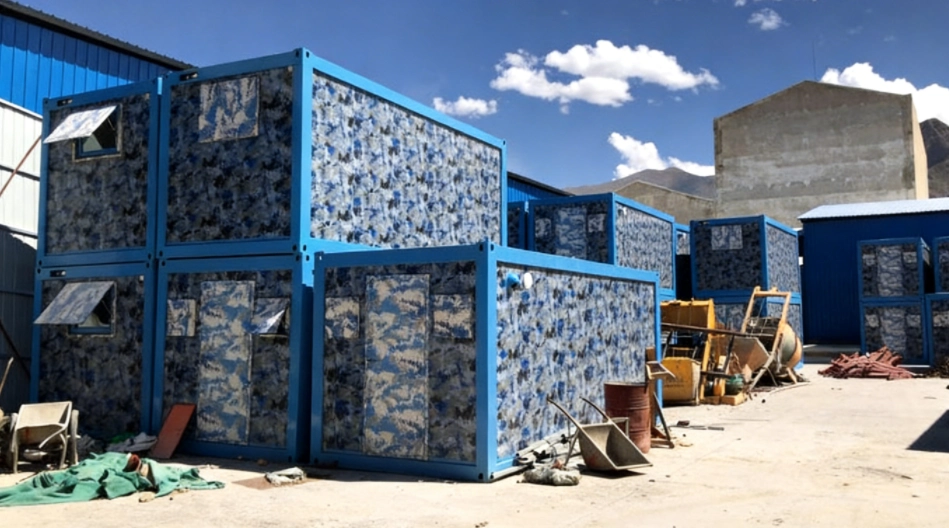
Why Rapid Deployment Infrastructure Is Critical for Military Camps?
Military operations rarely begin with fully developed infrastructure. Often, personnel reach before lasting structures stand ready. Thus, reliable and rapidly deployable shelter is not optional, but essential.
Immediate Shelter for Troops and Command Personnel
As personnel enter a fresh activity zone, they call for prompt lodging. Standard building might stretch over months, and that delay falls short for activity schedules. However, modular container buildings can be transported in advance and assembled on site in just hours or days.
Such units offer protected and climate-proof areas, so service members can relax, outline tasks, and recover and maintain operational readiness. Moreover, a solid lodging setup influences spirits, well-being, and total task outcomes quite directly. And even during short placements, suitable lodging brings a clear boost to activity preparedness.
Fast Deployment of Field Barracks and Operational Units
On-site barracks need to hold rest areas plus lead spaces, supply sections, and equipment rooms. Modular construction permits these varied areas to form speedily through uniform units that connect neatly like basic elements.
Since key frame efforts and inside fittings finish in the factory, the location tasks focus chiefly on placing and linking units. Consequently, this approach shortens build durations significantly, and such quickness matters greatly when forming an advance activity post or brief protection site.
Temporary Bases for Disaster Relief and Humanitarian Missions
Armed groups commonly join aid activities following quakes, floods, or similar events. In those cases, pace grows even more pressing. Structures must rise swiftly to aid search groups, care workers, and supply teams.
Pre-made modular buildings hand a workable fix for such activities. Units can act as short-term care spots, planning hubs, storage sites, or lodging for aid crews. Additionally, since they disassemble and move readily, these same forms can redeploy afterward in further activities or practice settings.
When the activity demand for swift structures appears evident, the subsequent issue shifts to how modular buildings truly enable this quickness.
How Do Modular Buildings Enable Rapid Construction for Emergency Military Camps?
The solid output of modular construction stems from its production style. Rather than forming each part at the location, most of the construction process takes place in controlled factory environments.
Factory Prefabrication and Standardized Production
During modular construction, frame elements and inside networks produce in factories along routine lines. Walls, frames, barriers, plumbing systems, electrical wiring, and interior finishes are typically installed before the units leave the factory.
This style enhances uniformity and cuts down on build mistakes. Furthermore, it ensures that climate holdups or hard location factors affect the forming process very little. And when units land at the location, on-site work is mainly installation-based rather than labor-intensive construction.
GS Housing runs multiple sizable modular production sites, boasting yearly output up to hundreds of thousands of units. This extensive making strength enables the firm to back initiatives needing many lodging units inside tight time slots.
Flat-Pack Transportation for Remote and Challenging Locations
Numerous armed bases sit remote from city hubs. Moving standard build supplies to those spots can prove costly and drawn-out. Flat pack container houses tackle this hurdle by reducing transportation volume.
In lieu of sending complete joined structures, components can be packed compactly and transported by truck, sea freight, or rail. Upon arrival at the site, these units can join rapidly using common lift gear.
Such haul output holds special merit for major placements, where numerous units require delivery to a distant post within narrow time limits.
Scalable Modular Expansion for Large Military Camps
Armed bases seldom keep fixed dimensions for extended times. As activities broaden, further lodging, storage, or activity structures might prove necessary.
Modular buildings permit the base design to expand steadily. Extra units can join in lines, pile upward, or organize into broader multi-space arrangements. Hence, this adaptability lets leaders build out structures phase after phase, all while avoiding disturbance to ongoing activities.
Following insight into how modular construction speeds up base growth, it holds equal weight to examine the clear traits that render container houses fitting for rigorous armed conditions.
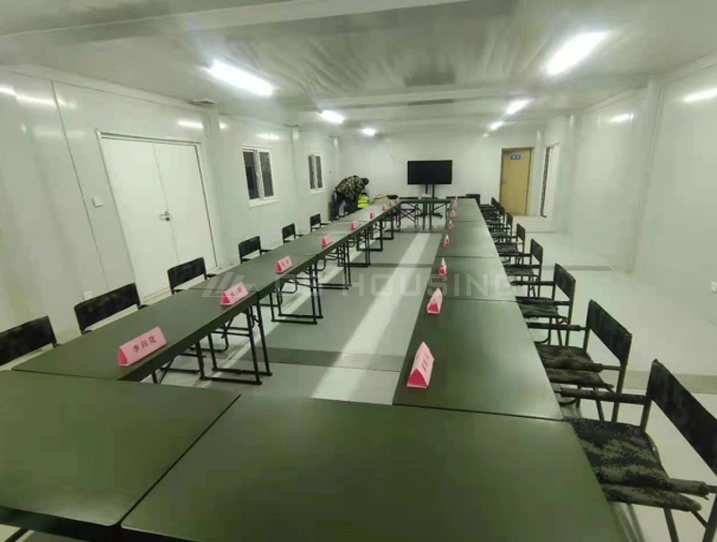
What Features Make Flat Pack Container Houses Suitable for Military Camps?
Armed structures must operate steadily beneath severe climate factors. Ranging from arid lands and peaks to seaside patterns, structures need to endure and safeguard effectively.
High-Strength Steel Structure and Weather Resistance
Flat pack container houses generally construct from galvanized steel frames that provide strong structural stability. These steel parts aim to fend off rust and endure fierce winds or substantial snow weights.
As these structures engineer as frame units, they endure repeated joins and shifts. Therefore, they prove perfect for initiatives where bases must relocate as activities advance.
Fire-Resistant Insulation and Safe Interior Systems
Safety standards prove particularly firm in armed settings. Modular container buildings employ fire-resistant insulation materials and pre-attached wiring networks that satisfy guard standards.
Flame endurance matters especially in work or fuel keep zones. Through weaving these guard elements into factory runs, setup mistake risks drop considerably.
Durable Design with Long Service Life
Though many armed bases label as interim, they frequently persist in use for years. Hence, the structures must manage prol
onged application.
Container modular forms design for prolonged service spans. Sturdy frame works, shield layers, and climate-proof materials assist in sustaining output, even post years of steady use.
Besides endurance, a further main benefit of modular setups is their capacity to back diverse base roles.
How Can Modular Container Buildings Support Full Military Camp Functions?
A modern military camp functions like a small self-contained community. It demands lodging, activity structures, care services, sanitation, and meal setups. Modular construction enables all these areas to develop via matching build units.
Modular Barracks and Troop Accommodation Units
Personnel lodging serves as the primary role in most armed bases. Container units can arrange to form single chambers, group sleeping areas, or tiered barracks.
These units can moreover incorporate warmth, cooling, illumination, and storage networks fitted during factory steps. Consequently, this yields a lodging setting that aids relaxation and renewal, even in far-flung activity zones.
Command Offices, Medical Rooms, and Communication Centers
Activity linking demands solid work areas for leaders and equipment staff. Modular buildings convert smoothly into lead spaces, assembly rooms, or linking hubs.
Medical facilities are another essential component. Container units can shape as check areas, care chambers, or even portable ground hospitals able to back urgent activities.
Dining Halls, Sanitary Units, and Support Facilities
Routine in an armed base calls for meal halls, cooking spots, washing structures, sanitary facilities, and storage buildings. Modular systems permit these aid roles to blend into the base design.
As the units share uniform sizes and frame networks, they link without hitches among themselves. This eases outlining and permits base shapers to form effective designs absent intricate engineer tweaks.
Bearing all these strengths in view, picking the proper supplier emerges as a significant phase toward triumph in any armed structure initiative.
Why Choose GS Housing for Emergency Military Camp Projects?
Background, production ability, and build insight all weigh in when forming structures for protection or aid runs.
Military Containerized Housing Units for Field Barracks
GS Housing crafts container housing systems particularly fitted for on-site actions. These structures aim to shift promptly, join simply, and uphold with scant supplies.
Their unit style enables them to operate as lone parts or as vast linked base networks.
Type-A and Type-B Flat Pack Container Houses for Large Camps
The company’s flat pack container housing systems shape for adaptable setups. Single units can fill roles as offices, sleeping areas, sanitation spots, cooking zones, or lead chambers.
For bigger bases, various units can stack or spread level to create intricate forms like tiered barracks or activity centers.
Customizable Modular Layouts for Different Mission Needs
Each armed run bears distinct structure demands. Certain actions need compact front stations, whereas others encompass vast drill foundations or supply centers.
GS Housing collaborates with initiative outliners to craft unit designs that align with activity requirements. Spanning from lodging sections to care units and protection points, each unit can modify to suit the run context.
Start Your Modular Military Camp Project with GS Housing
Swift setup structures cease to serve as indulgences for armed actions. Rather, they constitute a workable essential in a realm where runs frequently commence with constrained time and resources.
Modular construction offers a dependable fix. By relocating much of the forming procedure to managed factory contexts, it proves feasible to supply vast quantities of working structures in quite brief durations. Hauling grows more effective, setup accelerates, and broadening simplifies notably.
Through its extensive making grid, unit build background, and role in structures and aid initiatives worldwide, GS Housing positions itself aptly to aid urgent armed base formations. Irrespective of whether the need spans a brief front foundation, a calamity reply site, or an enduring activity base, modular container buildings furnish a workable route onward.
If you are planning an emergency military camp project, GS Housing can provide customized modular building solutions based on your operational requirements. Contact us to receive a detailed project proposal and quotation.
FAQ
Q1: How quickly can a modular military camp be installed?
A: Setup time hinges on initiative scale, yet modular units typically join in several days post-delivery, since most elements pre-make in the factory and thus location build remains slight.
Q2: Are container modular buildings suitable for harsh environments?
A: Yes. Sturdy steel frames, climate-proof layers, and barrier wall networks permit modular buildings to run in arid zones, peaks, seaside regions, and additional tough weathers.
Q3: Can modular military camps be relocated after deployment?
A: Frequently they can. Flat pack container houses design for repeated joins and hauls, thereby enabling them to disassemble and reemploy at alternate sites as runs evolve